
Mailto Links vs Contact Forms: Which Is Better for Feedback? (2026)
Should your website use a mailto link or a contact form? In 2005 we argued that mailto links were bad for feedback, because clicking one launched a desktop email program that often wasn’t set up, especially on public or library computers. Twenty years later phones and webmail have changed the picture, but the core problems remain: mailto links expose your email address to spammers and still fail for many visitors. Here’s how mailto links compare with contact forms in 2026, and when each one makes sense.

Quick answer: For most websites, a contact form is better than a mailto link. Forms work on any device without a configured email app, hide your address from spam bots, and let you collect structured details and filter spam. Mailto links are fine as a secondary option for visitors who prefer their own email, especially on mobile, but obfuscate the address and pair them with a form.
Table of Contents
What is a mailto link?
A mailto link is an HTML link that starts with mailto: followed by an email address, such as <a href="mailto:hello@example.com">. Clicking it asks the device to open its default email app with a new message addressed to you. You can also prefill the subject and body.
Problems with mailto links
They depend on the visitor’s email setup
Back in 2005 the experience went like this: the hard drive whirred while Windows hunted for Outlook Express or Eudora, a compose window opened, and then the message never sent because the account wasn’t configured, or you were in an internet cafe where email programs were disabled. We ended up scribbling the address on our palm to type into webmail.
Things are better today, but not fixed. On a desktop where people use Gmail or Outlook in the browser, a mailto click may open an unused Mail app or do nothing at all unless the browser is set as the mail handler. On shared, school and work computers it often fails.
They expose your email address to spam bots
A plain mailto address sits in your page’s HTML, where harvesting bots can scrape it. Expect more spam once it’s published. See how to protect your email address from spam bots on your website.
You get unstructured messages
Emails arrive with whatever the sender types: no order number, no topic, missing details. You then spend time asking follow-up questions.
Benefits of contact forms
- Works everywhere: visitors type in the browser and click Send. No email app needed.
- Hides your address: the destination email isn’t in the page code.
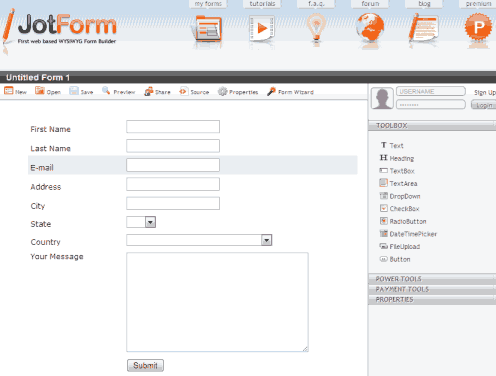
- Structured fields: ask for name, email, topic and order number, and route messages to the right person.
- Spam protection: add honeypot fields, Akismet or an invisible check like Cloudflare Turnstile.
- Integrations: send entries to a CRM, help desk, spreadsheet or Slack.
- Confirmation: show a thank-you message so visitors know it worked.
Downsides of contact forms (and fixes)
- Messages can get lost: form emails sent from your server may land in spam. Use an SMTP service or a form plugin that logs entries, and test it regularly.
- No copy for the sender: turn on an auto-reply or “send me a copy” option.
- Accessibility: use visible labels, clear error messages and avoid hard CAPTCHAs.
- Some people prefer email: add your address in a spam-resistant way for those visitors.
Best contact form options in 2026
- WordPress: WPForms and Contact Form 7 are popular plugins.
- Any website: Google Forms, Tally and Formspree work without a server-side setup.
Compare more tools in our list of free contact form services and generators.
When a mailto link still makes sense
- Mobile-heavy audiences, since phones open the Mail or Gmail app reliably.
- Personal sites and portfolios where people expect to email you directly.
- A secondary “or email us” option next to a form.
If you use one, keep it short, add a prefilled subject so you can filter messages, and use a dedicated address that you can replace if spam gets out of hand. More tips: how to protect your email from spam when you share it online.
FAQ
Are mailto links bad for SEO?
No. They don’t hurt rankings. The issues are spam and user experience, not SEO.
Why does my mailto link not open anything?
The device has no default email app set. On desktop, choose a default mail app in system settings or allow Gmail or Outlook in the browser to handle mailto links.
Can spammers read a contact form’s email address?
Usually not. A properly built form sends messages from the server, so your address isn’t shown in the page source.
Should I use both a form and an email address?
Yes, many sites do. Offer the form as the main option and a protected email address for people who prefer email.
Stuck on a gift? Try our free Gift Idea GeneratorIdeas for anyone by age, job, interests and budget, with Amazon.com and Amazon.in linksFind gifts →Get our free weekly email: new tech guides and tools, no spam.
New and updated tech guides, a free tool worth bookmarking and one useful pick, once a week. No spam, unsubscribe anytime.
One email a week. Unsubscribe anytime. See our privacy policy.



I hate feedback forms on the websites of companies with whom I do business. Several of them have broken email address validation scripts. They say that my preferred email address is not valid — and refuse to accept my message unless I give them an address that I don’t check nearly as often.
It’s like the “use this browser or we won’t talk to you” mentality with which some websites are designed.
Bottom line: Make it difficult for your customer to talk to you, and they’ll be motivated to become someone else’s customer instead.
“Darwin Award” wannabes refuse all input channels other than a browser-based feedback form. Let the customer decide whether they want to use a browser-based form. Give them an email address to use or be prepared to lose them as a customer.
Nope guys, I totally agree with this article. Spammers BITE!!!
I much rather USE a form when I visit sites for the reason above. I really did used to go through all that crappy hassle with e-mail programs opening up I had no idea how to use, etc. FRUSTRATING!!
However, when there is a form, it’s so much easier and I know it’s gonna make it to the soon-to-be recipient.
Not to mention lots of the auto-responder programs out there send the ‘sender’ a copy of the e-mail message just sent VIA form.
Not bad. ;-)
Agree that placing your e-mail on a graphic first is cool, however it’s not possible to cut and paste. If it’s a long e-mail addy, that’s a pain, too.
I do like using the blahblah[at]suchandsuch[dot]com
Still a little of a pin for copy/paste, but at least you can.
People with decent setup either have their e-mail client integrated into the browser (as I have with Opera’s M2), or have their e-mail client running hidden in the tray.
Of course, your comment may be valid for some people, but for me personally an e-mail link is much better.
What Yaron said. plus, your scenario is very far fetched… I mean if people can’t send email they’re faked anyways.
I *hate* feedback forms. It’s a nice way for folks to get an untrackable question that I may forget about later. With email I can resend them the question 2 days later with an “are you alive?” comment.
I still think an email is better.
1. I know what I send and where I send it to, and I know I have a copy.
2. If I suspect I’ll need further contact, keeping the email address is usually easier than maintaining a bookmark for a contact form.
The writing on the palm was obviously an exaggaration, but copy&paste works well enough for this to hardly ever be a problem.
And if you’re using firefox, there is this extension (not related to me in any way, I’m just using it) which connects those mailto links directly to webmail interfaces.