
Google Page Layout Algorithm: Ads Above the Fold and SEO
Google’s page layout algorithm was a 2012 update that lowered rankings for sites with too many ads above the fold and too little content. This article explains what the update did, how we checked our own pages back then, and how to keep ads from hurting your search traffic today.
Quick answer: In January 2012 Google announced a page layout algorithm change that targeted pages where large ads pushed the main content below the fold. Today the same idea is part of Google’s page experience guidance, which asks whether ads disrupt the main content. Keep the main content visible on first load, limit ads near the top and avoid intrusive pop-ups.
Table of Contents
What the page layout algorithm did
When Google announced the change, the message was simple: if visitors have to scroll past ads to find your content, your traffic from Google could drop. The update targeted sites where large ad blocks filled the area above the fold, the part of the page people see without scrolling.
The earlier Google Panda update had already hit sites with thin content and a high ad-to-content ratio, and many webmasters cut back their ads and removed low quality pages. The page layout update went further and looked at where the ads sat. Ads above the fold get high visibility and high click rates, so publishers love placing them there. Google said normal ad placement above the fold was fine; only pages where ads were excessive and the content was hard to find would be affected.
How we checked our own pages in 2012
Google suggested its Browser Size tool to see how much of a page people actually see at common screen sizes. I ran QuickOnlineTips through it and got this result:
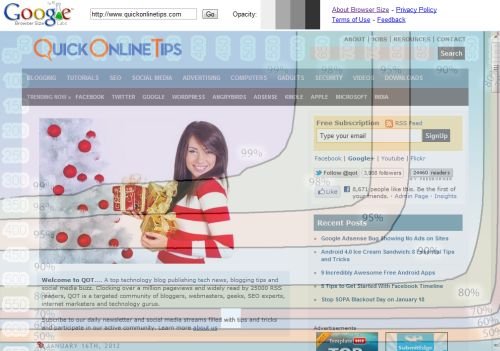
The 90% contour meant that 90% of visitors had a browser window at least that size. The sizes were for the visible page area, without toolbars and status bars, so the real space was even smaller. The test made it clear that ads can take up most of the screen for people on smaller displays. The Browser Size tool is long gone, but the lesson still applies.
Page layout algorithm today: page experience
Google no longer talks about the page layout algorithm by name. Its page experience guidance covers the same ground with self-assessment questions, including:
- Are ads limited so they don’t distract from or disrupt the main content?
- Do pages avoid intrusive interstitials (pop-ups that block the content)?
- Can visitors easily tell the main content apart from everything else?
- Does the page work well on mobile devices?
How to check if your site is too ad heavy
- Load your page on a phone and on a small laptop screen. Is the title and the start of the article visible without scrolling?
- Use your browser’s developer tools to preview common mobile and desktop screen sizes.
- Count the ad units above the fold. One well-placed unit is normal; a stack of large banners before the first paragraph is not.
- Check for layout shift. Ads that load late and push text down hurt readers. Test your pages in PageSpeed Insights and reserve space for ad slots.
- Remove intrusive pop-ups that cover the content as soon as a visitor arrives from search.
If your traffic is down
Look again at your ad placement and remove large ad blocks that take over the prime screen area. Then make the design changes, wait for Google to recrawl your pages, and watch Search Console over the following weeks. Recovery is not instant. For a wider checklist, see the 15 steps we took to fight Panda and Penguin.
FAQ
Is the page layout algorithm still active?
Google no longer lists it by name. Its current page experience guidance still asks whether ads disrupt the main content, so the advice is the same.
Are ads above the fold bad for SEO?
Not on their own. A normal ad above the fold is fine; problems start when ads dominate the screen and the content is hard to find.
What does above the fold mean on a website?
It is the part of the page visible without scrolling. On phones it is much smaller than on desktop screens.
How long does recovery take after removing ads?
Google has to recrawl and reassess your pages, which can take weeks. There is no fixed timeline.
Stuck on a gift? Try our free Gift Idea GeneratorIdeas for anyone by age, job, interests and budget, with Amazon.com and Amazon.in linksFind gifts →Get our free weekly email: new tech guides and tools, no spam.
New and updated tech guides, a free tool worth bookmarking and one useful pick, once a week. No spam, unsubscribe anytime.
One email a week. Unsubscribe anytime. See our privacy policy.



Thanks for your detailed guide. I have also put down my ads above the fold and applied only one to get better Pagerank.
I’m not quite understand how Google will penalizes by its new algorithms but I believe this changes will bring benefit to readers.
Badly hurt with this ..removed everything now ..hope things get stable again !
Very Informative post. Time to redesign the website and move things around
How can Google behave like that..Most of my Google adds are above the header area.Google ad sense encourages us to use ads in prime area.where as Google in its search is effecting the websites with ads..Google has gone mad..:-(
Yes..I agree completely with Google here..I found many a sites dumping in ads in prime areas of websites literally confusing the customers or users to click the ads.Google always rocks.and Thanks for sharing this valuable info with us..
This is really strange. Google Adsense wants ads above the fold… Google search doesn’t… now what?
This is good approach by Google but comeon they always ask for putting ad above the fold for better CTR (Adsense)…. But from reader perspective its good…Google should also penalize those who keep adsense or lots of ads in between the post and which gives a bad experience…
Googling is rolling lots of panda update these days !! Lot of people getting decrease in traffic !
Don’t know what Google is upto..??
One thing which I’m not sure about is does it mean: Ad between the post will also be bad for SEO..As it usually stays after the fold..Though from reader point of view its bad..!!
All webmasters will have to tweak and get more content above the fold, wherever the ads are.
Hi,
I like your writing on Google Penalizes Traffic to Above-the-Fold Ad Heavy Sites. Its very helpful for my business as I want to traffic my site on Google. Keep such writing.
Thanks
I wonder if having banner in sidebar, leading to your other site, above the fold, will hurt SEO, too.