
7 Steps to Stop RSS Feed Scraping and Content Theft (2026 Update)
Want to stop RSS feed scraping and content theft? Scraper sites copy blog posts automatically, often straight from your RSS feed, and sometimes their copies even rank above your original article in search results. All bloggers experience RSS scraping to some extent and it is simply not possible to go after every blog with a DMCA takedown request.
Table of Contents
Stop RSS Scraping & Content Theft

Quick answer: Add a copyright notice and links back to your site in your RSS feed, consider a summary-only feed, find copies with Google searches or Copyscape, block image hotlinking, and file DMCA takedown requests with Google and the scraper’s web host. Report scraper sites that carry ads to the ad network.
You can keep complaining, but here are some simple ways we use to deal with scraper sites engaging in your content theft.
1. Display RSS Feed Copyright Notice
To deal with sites republishing RSS, we created the Simple feed copyright WordPress plugin which adds a copyright notice as well as links back to the blog url and permalink of the post. This plugin has already been downloaded thousands of times from the official WordPress Plugins repository.
This way republished content not only gets you backlinks, but also lets Googlebot and readers of the scraper site know that the original content was from your site.
2. Find Scraped Content on Google Search
Of course the easiest way is to search for your latest post title within quotes on Google and all search results which have the same title will be detected. You can ignore the many sites which syndicate your headlines, but you MUST find the sites which republish your content.
If you want a more powerful content theft checker, I prefer to use Copyscape Premium – a useful online plagiarism finder tool for detecting copies of our web content.
3. Stop Image Hotlinking from Scraper Sites
After you find the scraped content, it is mostly not possible to stop them from republishing. So we identify the site and then see how we stop image hotlinking by these sites. You can choose to display a copyright image of your choice to replace this.
This really works as we switch hotlinked images with a bright green notice to indicate the image belongs to our site and post our short url QOT.co which is easy to type should people decide to check the original source. This works even if they decided to remove copyright notices.
See how our image messes the site of those reusing our images.

4. Show Copyright policy on Your Blog
This hardly works as most RSS scrapers hardly ever have a contact page, publicly displayed email or comment forms in which you can get a response to requests to stop RSS scraping.
If the contact form is there, you can send them the link to your copyright policy, and some scrapers might decide to remove the auto publishing bots from republishing your site, fearing lawsuit threats.
5. Report Spam to Google
If these sites rank higher, Google wants to know. This is what takes these scrapers off search engines results to the bottom of the queue. Google has this form to report spam and quality issues. You can fill this up and complain about these sites ranking higher than your site in search engine results.
Remember not to overdo the reporting and only report genuine spam. Of course you can file a DMCA request and track its progress in Google’s legal removals dashboard, which is the most effective way to get copied content removed from Google Search.

6. Stop the Site Income
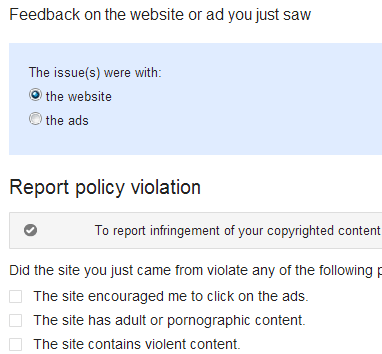
Many such sites may carry Adsense ads, and if you report such Made-for-Adsense sites, Google will be happy to prevent paying advertisers from wasting their money.
Most ads carry a small AdChoices icon; click it to report problems with the ad or the site it appears on. Blocking the flow of free money makes the scraping futile with no income to justify the effort.
7. Report to Web Hosting Provider
Web hosting companies take web spam very seriously and they will take prompt action to sites hosting or engaging in illegal activities. Find webhosting company of any website and then report using the site web hosting company contact forms. They will take care of the rest, if it is a genuine request.
More ways to protect your content in 2026
- Use a summary feed: in WordPress, go to Settings → Reading and set “For each post in a feed, include” to Excerpt. Scrapers then only get a teaser with a link back to you.
- Block bad bots: services like Cloudflare can block known scraper bots and AI crawlers you don’t want, while still allowing Googlebot.
- Control AI training: add rules for tokens like Google-Extended and GPTBot in robots.txt if you don’t want AI companies using your posts for training.
- Keep internal links in posts: scraped copies carry your links back to the original, which helps Google identify the source.
- Get indexed first: keep your XML sitemap updated so Google finds your post before the copies.
Frequently asked questions
Can scraped content hurt my rankings?
Usually not. Google is good at identifying the original source and ignoring copies, but occasionally a scraper outranks you, which is when a DMCA request helps.
How do I file a DMCA takedown with Google?
Use Google’s legal removal request form, choose the copyright option and list the copied URLs and your original URLs.
Should I switch my RSS feed to excerpts?
If scraping is a big problem, yes. Full feeds are nicer for readers, so many bloggers keep them and rely on feed copyright notices instead.
Looking forward to how you deal with this in comments.



Always i found backlinks which i do not maked!! they are a lot of iranian websites (with .ir)i don’t know why and how they make it!!? but i will test your solutions, i hope that it will be helpful for me
Very useful information and thanks for sharing. Content thefts, copyright violation, and plagiarism are common. Your tips and links will surely help stop them.
Hello and thank you for the article. Do small websites need to worry about RSS scrapping and how can you tell if someone is scrapping your site?
Cool article about SEO and thanks for some useful tips. Can anyone out here tell me, once in how many days does google update the page rank and on what basis will google crawl in to our site?
Surely will follow these steps. Many of the website owners rather than writing their own articles, they use feeds to provide constantly changing content on their site. We have awareness about this and avoid such things…
I’ve had several search rankings of sites that have been scraping content from my blog. I’ve logged Google DMCA complaints against such content scrapping sites. Thanks the lovely tips and advice, I think I will follow some of the tips from here.
Even web spam reports work. Google reads every feedback, that’s why it is so good … and relevant.
Reporting Google is something I liked……but adding Copyright badge also helps.
I have also written about content scraping but your post is more thoughtful and detailed about rss feed scraping which is the main source of content scraping. Bookmarked your website on feedly. Take a look at my post also and let me know what you think
Would love to see your comment :)
Thanks and Regards
Deepak Arora
RSS feed scraping content thieves. And I found some great resources, including AntiLeech, a plugin that “helps prevent content theft by sploggers” and a detailed article explaining the benefits of AntiLeech Splog Stopper.
How can i Google Likes Spam Reports. please some body tall me?
Simple Feed Copyright looks like one great plugin, it kind of turns the table on the content stealing creeps, thanks for the informative article.
My website rank has been down due to scraping and that’s why i am not using feed services. Thanks for tips.
its you giving a good stuff…..Its really useful for next generation bloggers also….
Thanks for the post !!!!! Now a days these process will be taken by various spammer to earn money with popularity !!!!!!! Great Info !!!!!!
Thanks for the link to the WP copyright plugin. I dont know how much it will help, but I will be trying it.
Fantastic post and best blog! I happen to be a daily visitor to your blog (somewhat more like addict :P ) of this blog. Just wanted to say I appreciate your blogs and am looking forward for more to come!
Simple feed copyright plugin would solve a lot of my problems..Thanks for coming up with it..Much appreciated.
But what about the feedreader.com scraper, it’s fully blown scraper – uses iframes and do not link to original content and Google ranks it higher.. completely ridiculous. It seems they have mastered to trick Google post panda update.
What a nice tips. But how does it hamper a site?
Good to know this very helpful information. I am not aware of it. It’s probably the best time to have these tips be put to implementation. Thanks!
This is a great steps to stop RSS Feed Scraping. I would like to implement this in my site.
You might want to edit most instances of your featured word in the post so they indicate “scraping” instead of “scrapping” (trashing).
Recently i was suffering RSS Feed Scraping.From your post i will apply on my site .
Thanks for your important post.
These are awesome tips for newbies. I am going to implement the RSS copyright right now. Thanks!
All are nice but most of them are useful to wordpress users.So i suggest one tool for all bloggers that is “tynt”.This works well on all blogging platforms.If any one copies text from your blog after it shows attribution to your blog with your website address.Nice tool try it.
Very very helpful to others, thanks for share this with everyone
This article turns out to be very useful and enlightening..it is crazy to think that someone can ruin your site…the tools and methods suggested here can really be helpful for bloggers and webmasters..thanks for sharing..
I know a Spanish website which is scraping my content but the hosting company is also Spanish and ignores my emails.