7 Best Free AI Detector Tools in 2026 (and How Accurate They Are)
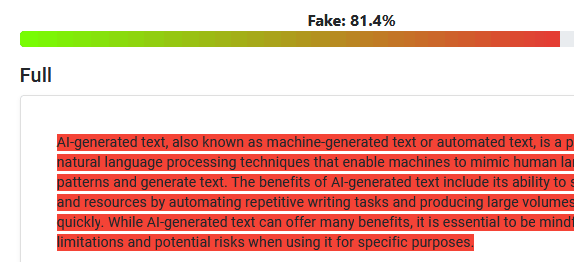
Free AI detector tools can tell you if a piece of text was likely written by AI. Need to check if a piece of text was written by ChatGPT, Gemini or Claude? These tools analyse writing patterns and estimate how likely it is that text was AI-generated. Teachers use them for essays, editors for freelance articles and site owners for guest posts. But no AI detector is 100% accurate, and some flag human writing as AI. Here are the best free AI detector tools in 2026, their free limits, and how to use the results sensibly.
Quick answer: For reliable free checks, use GPTZero or Copyleaks, then confirm with a second tool such as Pangram or QuillBot. Treat any score as a signal to look closer, not as proof.
Table of Contents
Best free AI detector tools
1. GPTZero

GPTZero (external site, opens in new tab) was one of the first AI detectors and is still among the most popular, especially in education. It highlights sentences likely written by AI and gives an overall probability. The free plan, with a sign-in, includes a monthly word allowance, and paid plans add longer scans, plagiarism checks and Google Docs and Chrome integrations.
2. Copyleaks AI Detector
Copyleaks (external site, opens in new tab) detects AI text in more than 30 languages and can check long passages without an account. It also offers plagiarism detection and an LMS integration for schools and universities.
3. Pangram
Pangram (external site, opens in new tab) is a newer detector that has scored very well in independent and academic tests, with low false positives. The free tier allows a few checks a day.
4. QuillBot AI Detector
QuillBot’s AI Detector (external site, opens in new tab) is free with no sign-up and shows which parts look AI-generated, AI-generated and refined, or human-written. That’s useful because a lot of content today is a human-AI mix.
5. Scribbr AI Detector
Scribbr (external site, opens in new tab) offers a free AI detector aimed at students, with a per-scan word limit and no account needed.
6. Sapling AI Content Detector
Sapling (external site, opens in new tab) gives a quick free check for short text and highlights the sentences it thinks are AI-written. It’s best for emails, short answers and snippets.
7. ZeroGPT
ZeroGPT (external site, opens in new tab) is free and unlimited with no login, which makes it popular. However, tests show it has more false positives than the tools above, so don’t rely on it alone.
Retired AI detectors
OpenAI shut down its own AI Text Classifier in July 2023, citing low accuracy, and the old Hugging Face GPT-2 Output Detector was built for GPT-2 and doesn’t work well on modern models. If you see them recommended in older articles, use the tools above instead.
How accurate are AI detectors?
AI detectors look for statistical patterns, such as how predictable each word is (perplexity) and how much sentence length varies (burstiness). That works reasonably on unedited AI text, but accuracy falls sharply when text is paraphrased, edited by a human, or written by non-native English speakers, whose simpler phrasing is more often wrongly flagged.
- Use two or more detectors and look for agreement.
- Check longer samples: results on a few sentences are unreliable.
- Look for other evidence: drafts, version history, made-up facts or fake references.
- Never penalise someone on a score alone. Talk to the writer first.
Does Google penalise AI-generated content?
Not just for being AI-written. Google’s guidance on generative AI content (external site, opens in new tab) says it rewards helpful, original content however it’s made, but its spam policies target “scaled content abuse”: mass-producing pages mainly to rank. Showing real experience matters more than ever under Google’s E-E-A-T guidelines. Read more about whether AI-generated content can get a Google penalty.
Frequently asked questions
Which is the most accurate free AI detector?
In recent independent tests, Pangram, GPTZero and Copyleaks have performed best. Accuracy varies with the AI model and how much the text was edited, so use more than one.
Can AI detectors detect ChatGPT, Gemini and Claude?
The leading detectors are trained on text from all major models and can usually flag unedited output. Heavily edited or paraphrased text is much harder to detect.
Can AI detectors be wrong?
Yes. False positives happen, especially with short, formal or non-native English writing. A detector score is a probability, not proof.
Subscribe to our weekly tech newsletter
New tech guides, free tools and 2-minute fixes, once a week.
🎁 100 Tech Terms ebook comes free with every subscription.
Unsubscribe anytime. See our privacy policy.