AI Generated Content and Google Penalties: What Changed by 2026
Will AI generated content get your site a Google penalty? When ChatGPT launched, I warned bloggers in early 2023 that mass-produced AI articles could get them into trouble. Three years later, the answer is clearer. Google does not penalise content just because AI helped write it, but it has hit thousands of sites that used AI generated content to churn out unhelpful pages at scale. Here is where things stand in 2026.

Quick answer: Google’s policy is that AI generated content is fine if it is helpful, accurate and made for people. What gets penalised is “scaled content abuse”: publishing large amounts of low-value pages mainly to rank, whether written by AI or humans. Use AI as an assistant, add your own experience and fact-checking, and never publish raw AI output in bulk.
Table of Contents
What Google says about AI generated content
In February 2023 Google said it rewards “high-quality content, however it is produced”. Then the March 2024 core update changed the game. Google folded its helpful content system into core ranking and added a spam policy against scaled content abuse, saying it had cut low-quality, unoriginal content in search by about 45%. Many sites built on mass AI articles lost most of their traffic or were removed from search.
What can get your site penalised
- Publishing hundreds of AI articles with little editing or original value.
- Rewriting other sites’ articles with AI to avoid copying detection.
- Making pages on topics you have no knowledge of, just because they get searches.
- Fake reviews and “best product” lists without testing anything.
- Letting AI invent facts, statistics, quotes or sources.
How to use AI tools safely
- Use AI for ideas, outlines and first drafts, then rewrite in your own voice.
- Add first-hand experience: your tests, screenshots, photos, results and opinions. This is the “Experience” in Google’s E-E-A-T guidelines.
- Fact-check everything. AI still makes confident mistakes.
- Show who wrote it, with a real author name and bio.
- Publish less, but better. One great article beats ten generic ones.
- Write better prompts to get better drafts. Here are tips to get better answers from ChatGPT.
Can AI detectors catch AI content?
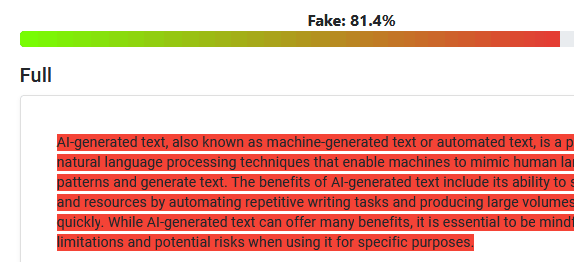
AI detection tools exist, but they are unreliable and often flag human writing as AI. Google does not need a detector: it judges whether a page is useful. See our test of AI detector tools to see how accurate they really are.
Should you disclose AI use?
Google suggests explaining how content was made when readers would reasonably want to know, such as AI-generated images or automated reports. It is also simply honest. A short note like “drafted with AI and reviewed by our editor” builds trust.
AI Overviews change the picture too
Google now shows AI Overviews at the top of many results, answering simple questions directly. Generic content that just repeats common knowledge is exactly what AI can summarise without sending a click. Original experience, data and opinions are what still earn visits in 2026.
FAQ
Does Google penalise AI generated content?
Not automatically. It penalises unhelpful content made mainly to manipulate rankings, including mass-produced AI pages.
Can I use ChatGPT to write blog posts?
Yes, as a helper. Edit heavily, add your own insights and check facts. Compare free and paid versions in our ChatGPT Plus review.
How much AI content is too much?
There is no percentage rule. If a page offers nothing a reader could not get from any AI chatbot, it is at risk.
Do you use AI tools for writing? Tell us how in the comments.
Get our free weekly email: new tech guides and tools, no spam.
New and updated tech guides, a free tool worth bookmarking and one useful pick, once a week. No spam, unsubscribe anytime.
One email a week. Unsubscribe anytime. See our privacy policy.